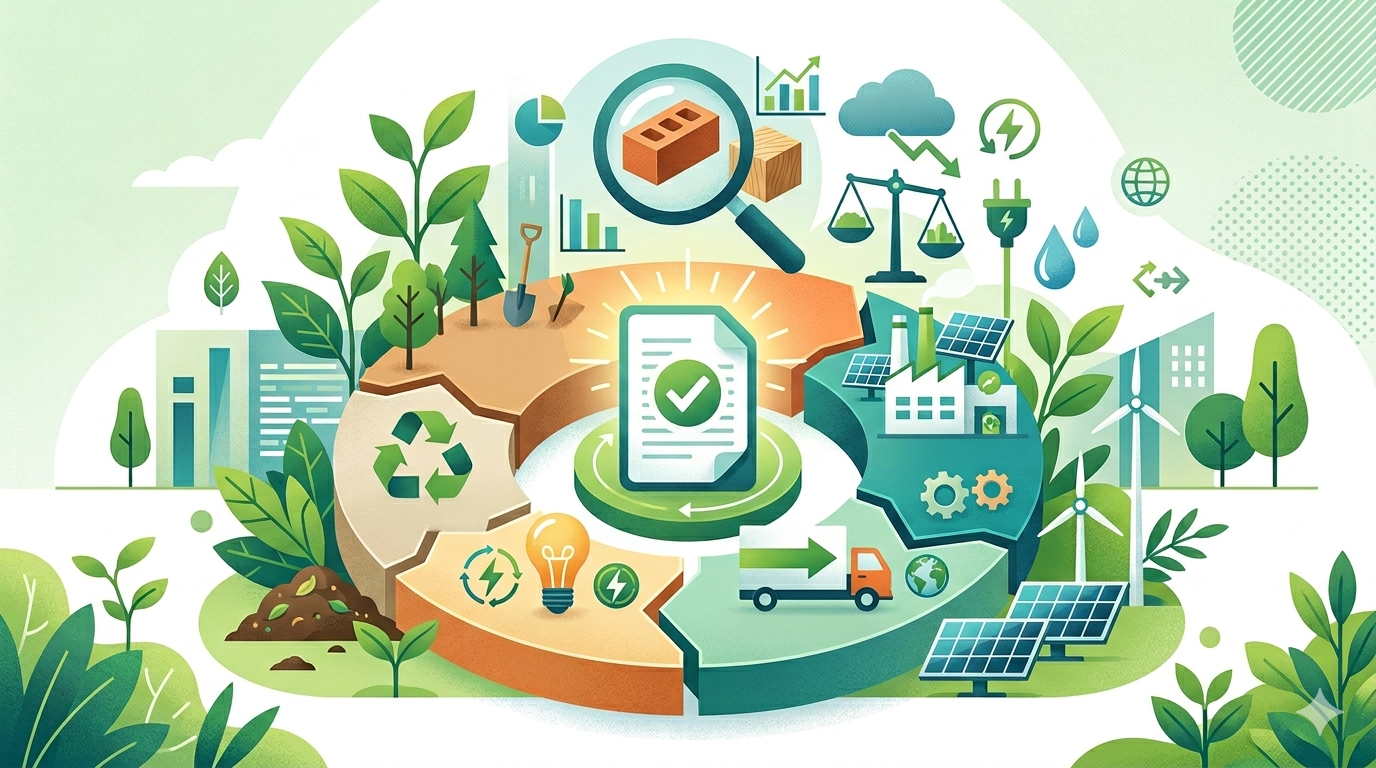
An EPD Environmental Product Declaration is a verified document that transparently reports the environmental impacts of a product throughout its lifecycle.
Rather than offering a sustainability label or rating, an Environmental Product Declaration (EPD) provides detailed, measurable data derived from lifecycle assessment (LCA). This enables fair product comparison and informed decision-making based on environmental performance rather than marketing claims.
As sustainability expectations grow across global supply chains, understanding how EPDs work — and how to use them — has become essential for procurement teams, manufacturers, ESG professionals, and policymakers.
This guide explains what an EPD Environmental Product Declaration is, how it is developed, what standards apply, and why it plays a critical role in sustainable procurement and corporate responsibility.
What Does EPD Environmental Product Declaration Mean?
An Environmental Product Declaration (EPD) is a standardised disclosure document that communicates quantified environmental data about a product across defined lifecycle stages.
It is sometimes referred to as a “Type III environmental declaration,” meaning:
- It is based on lifecycle assessment methodology
- It follows defined Product Category Rules (PCR)
- It undergoes independent third-party verification
Importantly, an EPD does not judge whether a product is environmentally “good” or “bad.” Instead, it presents verified environmental metrics so stakeholders can evaluate performance objectively.
Why are EPDs important?
Environmental Product Declarations are increasingly important for companies aiming to demonstrate sustainability and meet regulatory or market requirements.
Key benefits include:
- Transparent environmental impact reporting
- Improved credibility through third-party verification
- Support for green building certifications (e.g. BREEAM, LEED)
- Competitive advantage in procurement and tenders
- Compliance with environmental regulations
What Information Is Included in an Environmental Product Declaration?
An EPD Environmental Product Declaration typically contains:
- A detailed product description
- The declared functional unit (e.g., per unit, per square meter, per ton)
- Defined system boundaries (lifecycle stages assessed)
- Environmental impact indicators
- Resource consumption figures
- Waste generation data
- Data sources and assumptions
- Verification statement
Common environmental indicators reported include:
- Global Warming Potential (GWP)
- Ozone depletion potential
- Acidification
- Eutrophication
- Primary energy demand
- Water consumption
This structured transparency allows buyers to compare products using standardised environmental metrics.
Which Standards Govern an EPD Environmental Product Declaration?
Environmental Product Declarations are not arbitrary reports. They must comply with internationally recognised frameworks.
Key standards include:
ISO 14025
Establishes principles and procedures for Type III environmental declarations, ensuring transparency and comparability.
ISO 14040 and ISO 14044
Define lifecycle assessment methodology, forming the scientific foundation of EPD data.
EN 15804
Widely applied in the construction sector, harmonizing environmental reporting requirements for building products.
These frameworks ensure that an EPD Environmental Product Declaration follows consistent methodology and verification protocols.
How Is an EPD Developed?
Creating an Environmental Product Declaration involves a structured process:
1. Conducting a Lifecycle Assessment (LCA)
A lifecycle assessment evaluates environmental impacts across defined stages, which may include:
- Raw material extraction
- Manufacturing
- Transportation
- Product use
- End-of-life treatment
2. Applying Product Category Rules (PCR)
Each product type must follow specific PCR guidelines that define:
- Impact categories
- Calculation methods
- Reporting format
- System boundaries
PCR ensures comparability within product categories.
3. Independent Verification
Before publication, the EPD Environmental Product Declaration must be reviewed and validated by an accredited third party.
Only after this verification can the declaration be officially published.
Lifecycle Boundaries Explained
One of the most critical aspects of interpreting an EPD is understanding lifecycle boundaries.
Cradle-to-Gate
Covers impacts from raw material extraction through manufacturing.
Cradle-to-Grave
Includes product use and end-of-life disposal.
Cradle-to-Cradle
Accounts for recycling or reintegration into new production cycles.
Without consistent lifecycle boundaries, comparing two Environmental Product Declarations may lead to inaccurate conclusions.
Why EPD Environmental Product Declarations Matter for Sustainable Procurement
Procurement decisions increasingly require environmental data to support climate targets and responsible sourcing strategies.
An EPD Environmental Product Declaration supports procurement teams by enabling them to:
- Compare suppliers using standardised environmental metrics
- Quantify product-level carbon impact
- Identify lower-impact alternatives
- Improve supply chain transparency
- Support decarbonisation strategies
Rather than relying on general sustainability statements, EPDs provide concrete data that strengthens accountability.
The Business Value of Environmental Product Declarations
Beyond procurement, EPDs deliver strategic benefits across organizations.
Strengthened ESG Reporting
Verified lifecycle data supports carbon disclosures and sustainability reporting.
Risk Mitigation
Transparent environmental performance reduces reputational and regulatory risks.
Market Differentiation
Suppliers who publish EPD Environmental Product Declarations demonstrate environmental maturity and transparency.
Innovation Incentives
EPDs encourage manufacturers to improve material efficiency, energy use, and production processes to remain competitive.
What an EPD Does Not Measure
While comprehensive in environmental scope, an Environmental Product Declaration does not assess:
- Labor standards
- Social equity
- Human rights compliance
- Governance structures
- Ethical sourcing
For this reason, EPD analysis should be integrated into broader ESG and sustainable procurement frameworks rather than used in isolation.
How Organisations Should Use EPD Data Strategically
To unlock the full value of an EPD Environmental Product Declaration, organisations should:
- Embed EPD metrics into supplier evaluation systems
- Track environmental indicators over time
- Compare updated declarations for continuous improvement
- Align EPD insights with carbon reduction targets
- Use lifecycle data during product specification development
When environmental data informs procurement strategy, EPDs evolve from passive documentation to active business intelligence.
Frequently Asked Questions
What is the purpose of an EPD Environmental Product Declaration?
Its purpose is to provide transparent, verified environmental data so stakeholders can compare products objectively.
Are all Environmental Product Declarations comparable?
Only when they follow the same Product Category Rules and lifecycle boundaries.
Is an EPD a certification?
No. It is a disclosure document based on verified lifecycle data. It does not certify a product as sustainable.
How long is an EPD valid?
Typically five years, after which it must be updated and reverified.
The Growing Importance of EPD Environmental Product Declarations
As governments, investors, and customers demand greater environmental transparency, EPDs are becoming standard practice across industries — particularly in construction, manufacturing, and infrastructure.
Their structured methodology, third-party verification, and lifecycle transparency make them one of the most credible tools for communicating environmental performance.
Organisations that understand and apply EPD Environmental Product Declarations effectively position themselves for regulatory resilience, supply chain transparency, and long-term sustainability leadership.
Conclusion
An EPD Environmental Product Declaration is not simply a technical document — it is a mechanism for measurable environmental accountability.
By providing standardized lifecycle data, EPDs empower procurement professionals, sustainability teams, and decision-makers to move beyond assumptions and base purchasing decisions on verified environmental performance.
In a business environment where transparency is no longer optional, EPDs represent a critical bridge between environmental ambition and measurable action.