As organisations face increasing pressure to measure environmental impact accurately, Life Cycle Assessment (LCA) has become one of the most robust and internationally recognised methodologies for evaluating sustainability performance.
Unlike high-level carbon reporting or isolated footprint calculations, LCA provides a structured, science-based framework for analysing environmental impacts across a product or service’s entire life cycle — from raw material extraction to disposal or reuse.
Understanding the key stages of LCA methodology is essential for organisations aiming to improve environmental decision-making, strengthen ESG reporting, and support sustainable procurement strategies.
What Is Life Cycle Assessment (LCA)?
Life Cycle Assessment (LCA) is a systematic method used to evaluate the environmental impacts associated with all stages of a product’s life cycle. This includes raw material extraction, manufacturing, transportation, use, and end-of-life treatment.
The methodology is governed by internationally recognised standards, primarily ISO 14040 and ISO 14044, which define the structure and principles of LCA.
At its core, LCA answers one fundamental question:
What is the total environmental impact of this product, service, or system from cradle to grave?
What Are the Four Key Stages of LCA Methodology?
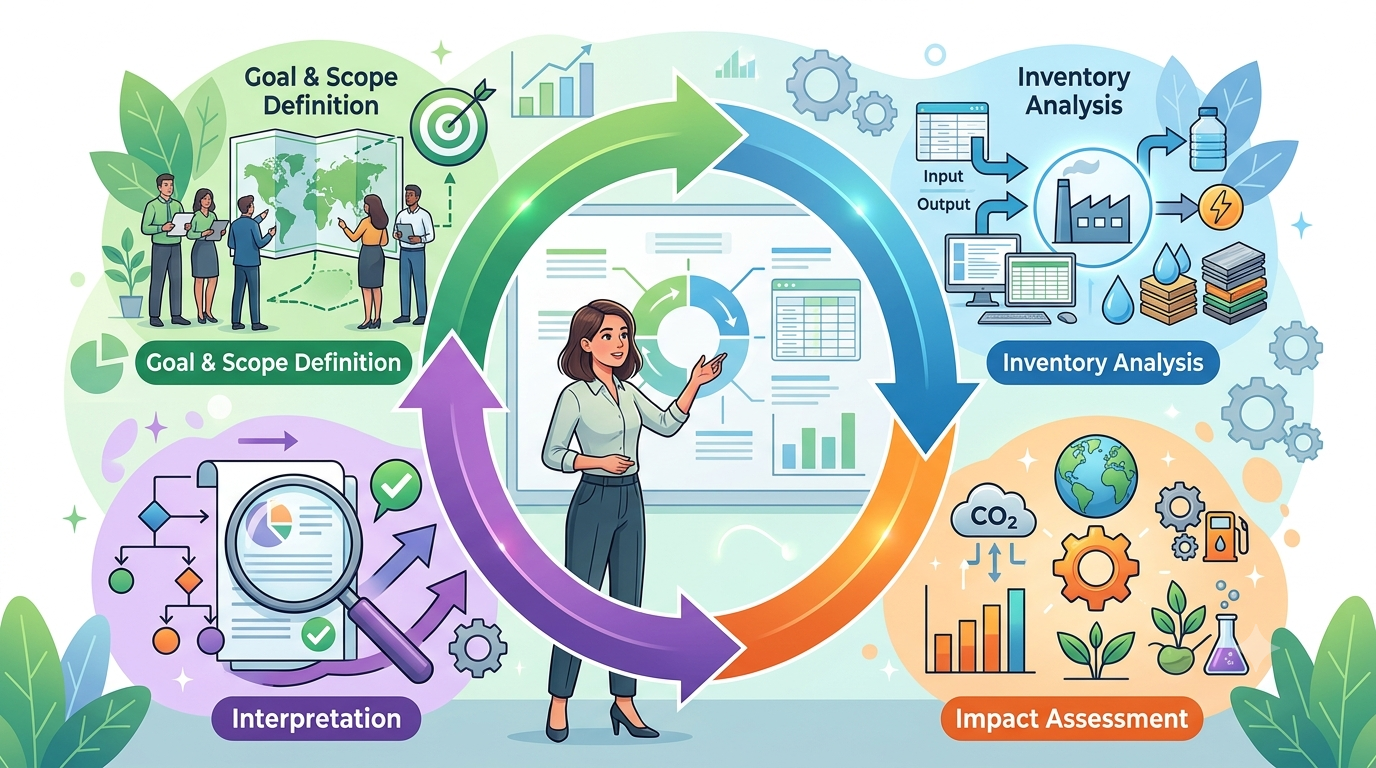
The Life Cycle Assessment framework consists of four structured stages. Each stage builds upon the previous one to ensure scientific accuracy and transparency.
Goal and Scope Definition
The first stage establishes the purpose, system boundaries, and level of detail required for the assessment.
Key elements include:
- Defining the objective of the study
- Identifying the intended audience
- Establishing system boundaries (cradle-to-gate, cradle-to-grave, etc.)
- Determining the functional unit (e.g., per product, per service hour)
- Setting assumptions and limitations
This stage is critical because it shapes the credibility and comparability of the results. Poorly defined boundaries can lead to misleading conclusions.
Strategically, organisations use this stage to align LCA objectives with broader sustainability frameworks, including procurement strategies guided by standards such as ISO 20400, where life-cycle thinking plays a central role.
Life Cycle Inventory (LCI) Analysis
The Life Cycle Inventory stage involves collecting and quantifying data on inputs and outputs throughout the product system.
This includes:
- Energy consumption
- Raw material usage
- Water consumption
- Emissions to air, water, and soil
- Waste generation
The LCI stage is data-intensive and often requires collaboration across supply chains. Accuracy here directly influences the reliability of final impact results.
For organisations with complex global suppliers, this stage can reveal hidden environmental hotspots that are not visible through standard carbon accounting.
Life Cycle Impact Assessment (LCIA)
The Life Cycle Impact Assessment stage translates inventory data into environmental impact indicators.
Common impact categories include:
- Global warming potential (carbon footprint)
- Acidification
- Eutrophication
- Resource depletion
- Human toxicity
- Ozone depletion
This stage answers the question: What do these emissions and resource uses actually mean in environmental terms?
Impact assessment provides the scientific basis for comparing alternative materials, processes, or suppliers.
Interpretation
The final stage synthesises findings, evaluates limitations, and draws conclusions aligned with the original goal and scope.
Interpretation involves:
- Identifying significant impact contributors
- Assessing data quality and uncertainty
- Performing sensitivity analysis
- Providing actionable recommendations
This stage transforms technical results into strategic insight.
For decision-makers, interpretation is where LCA becomes valuable, enabling informed procurement, product design, and policy decisions.
Why Is Life Cycle Thinking Increasingly Important?
Life cycle thinking moves organisations beyond single-stage environmental assessments.
For example:
- A product with low manufacturing emissions may have high end-of-life impacts.
- A cheaper raw material may generate higher upstream emissions.
- Transport distance may significantly affect overall carbon footprint.
Without a full life-cycle perspective, sustainability decisions can unintentionally shift impacts rather than reduce them.
This is particularly relevant in sustainable procurement frameworks, where organisations are encouraged to evaluate suppliers based on total life-cycle impact rather than initial cost.
How Does LCA Support Sustainable Procurement and ESG Reporting?
LCA methodology strengthens sustainability reporting by providing defensible, standardised environmental data.
It supports:
- ESG disclosures
- Product Environmental Declarations (EPDs)
- Carbon reduction strategies
- Circular economy initiatives
- Supplier evaluation frameworks
When integrated into procurement strategy, particularly under sustainability guidance such as ISO 20400, life-cycle assessments enable organisations to make evidence-based sourcing decisions.
Rather than relying on assumptions, LCA provides measurable environmental performance indicators.
What Challenges Do Organisations Face When Conducting an LCA?
Despite its strengths, LCA implementation can present challenges.
Common barriers include:
- Data gaps within supply chains
- Resource-intensive data collection
- Complexity of modelling tools
- Interpretation of impact categories
- Managing uncertainty in assumptions
However, these challenges are typically outweighed by the value of structured environmental insight, particularly for organisations seeking long-term sustainability leadership.
When Should an Organisation Conduct a Life Cycle Assessment?
LCA is particularly valuable when:
- Developing new products
- Comparing alternative materials
- Evaluating packaging redesign
- Assessing supply chain sustainability
- Supporting environmental claims
- Preparing ESG or sustainability reports
Organisations operating in regulated sectors or public procurement environments often rely on LCA to substantiate environmental performance claims.
Frequently Asked Questions (FAQs)
What are the four stages of Life Cycle Assessment?
The four stages are Goal and Scope Definition, Life Cycle Inventory (LCI), Life Cycle Impact Assessment (LCIA), and Interpretation.
Is LCA required for ISO certification?
LCA is not mandatory for most ISO certifications, but it supports environmental management systems such as ISO 14001 and sustainable procurement guidance.
How long does a Life Cycle Assessment take?
The duration varies depending on product complexity and data availability. It can range from several weeks to several months.
Conclusion
The key stages of Life Cycle Assessment methodology goal and scope definition, inventory analysis, impact assessment, and interpretation — form a structured and scientifically robust framework for evaluating environmental performance. In an era of heightened ESG scrutiny and supply chain accountability, LCA enables organisations to move beyond surface-level sustainability metrics and adopt data-driven environmental decision-making.
When integrated with broader sustainable procurement strategies and governance frameworks, life cycle thinking becomes a powerful tool for reducing impact, strengthening resilience, and supporting long-term responsible growth.