Life cycle assessment has become one of the most consequential tools in the sustainability professional’s arsenal. As organisations face growing pressure to substantiate their environmental claims — from regulators, investors, and supply chain partners alike, the methodology behind the numbers matters as much as the numbers themselves.
Choosing between a cradle-to-grave and a cradle-to-gate approach is not merely a technical decision; it shapes what your data can say, what it cannot, and how credible your reporting will be under scrutiny.
Today, we break down both methodologies, explore where each one is best applied, and examine what the choice means for procurement strategy, supplier engagement, and ESG disclosure.
What Is the Difference Between Cradle-to-Grave and Cradle-to-Gate LCA?
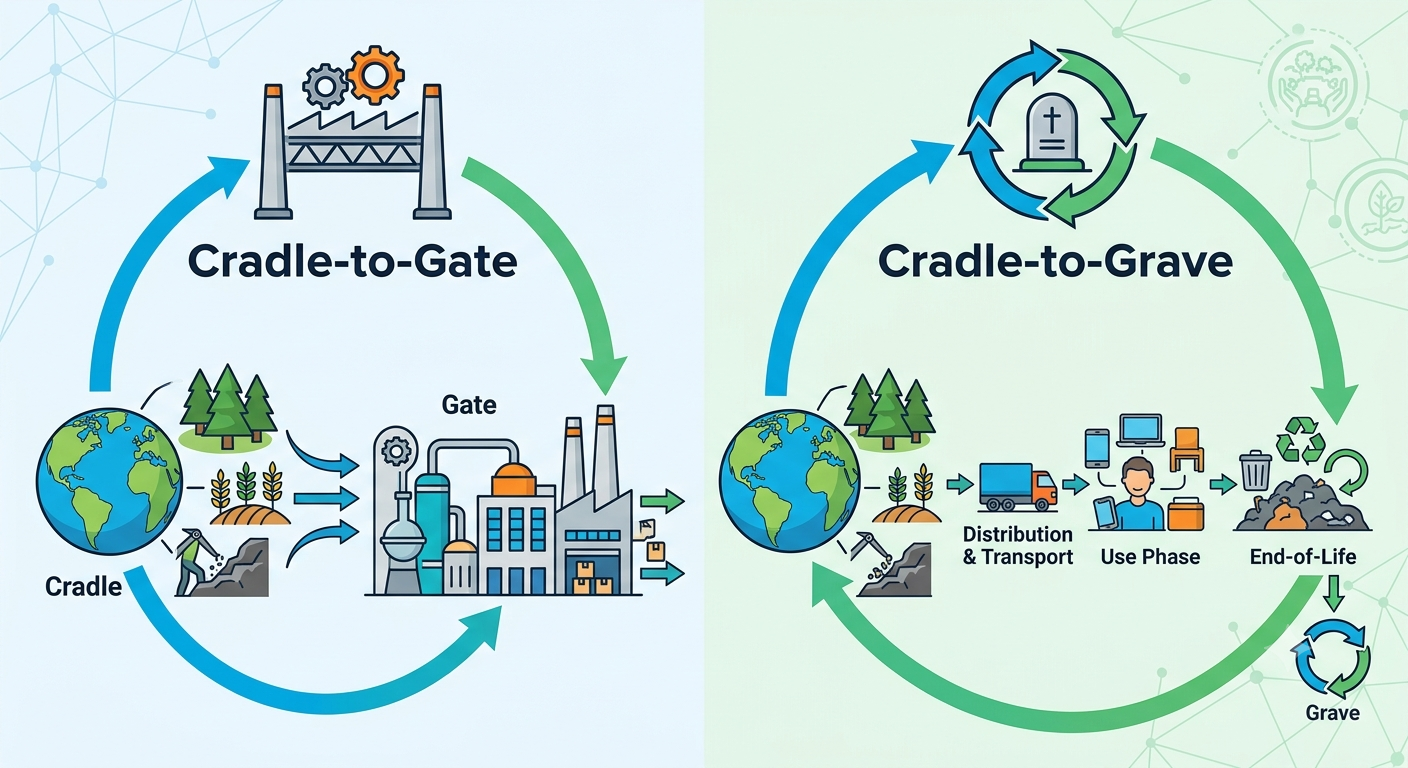
Cradle-to-grave LCA measures the full environmental impact of a product or service across its entire lifecycle — from raw material extraction through manufacturing, distribution, use, and final disposal or end-of-life processing. It is the most comprehensive form of life cycle assessment and captures the totality of environmental burden associated with a product.
Cradle-to-gate LCA covers only the upstream portion of that lifecycle — from raw material extraction to the point at which a product leaves the factory gate, before it reaches the consumer or enters the next stage of the supply chain.
It is a partial assessment, deliberately bounded, and widely used in contexts where downstream data is unavailable, irrelevant, or outside the scope of the reporting objective.
The distinction matters because the two methodologies can produce significantly different environmental profiles for the same product, and using one when the other is more appropriate can undermine the integrity of your sustainability disclosures.
When Should You Use Cradle-to-Grave vs. Cradle-to-Gate?
When the objective is to understand and communicate the full environmental footprint of a product, service, or organisation, cradle-to-grave is the appropriate methodology. It is particularly relevant for carbon footprinting under frameworks such as the GHG Protocol, and for reporting against science-based targets where Scope 3 emissions, including use-phase and end-of-life, are material.
What makes cradle-to-grave the right choice for ESG reporting?
For procurement teams, cradle-to-grave data provides the most complete picture of a supplier’s environmental impact. It is also the methodology expected under an increasing number of regulatory disclosure requirements, including the EU’s Corporate Sustainability Reporting Directive (CSRD).
When is cradle-to-gate LCA more appropriate?
Cradle-to-gate is the more practical choice when the use phase and end-of-life of a product vary significantly depending on the buyer, when data to define downstream impacts is unavailable, or when the organisation’s accountability reasonably ends at the point of purchase. It is commonly used in Environmental Product Declarations (EPDs), construction material assessments, and supplier-level emissions reporting where downstream data is outside the supplier’s control.
It is also a pragmatic starting point for organisations building out their LCA capability incrementally, giving procurement teams a workable baseline that can be extended over time as data quality and organisational capability improve.
How Does LCA Methodology Choice Affect Procurement Strategy?
The methodology you select has direct implications for how you assess, compare, and engage suppliers.
A cradle-to-gate framework focuses supplier conversations on production-stage impacts — energy use, material sourcing, manufacturing emissions. A cradle-to-grave approach broadens that conversation to include how a product performs in use and what happens to it at end-of-life.
For procurement professionals working within the ISO 20400 framework, LCA methodology selection should align with the sustainability criteria embedded in your procurement policy. ISO20400.org provides a knowledge base and community of practice that supports procurement teams in applying internationally recognised standards — including aligning LCA approaches with broader supply chain sustainability objectives.
What are the limitations of each methodology?
Cradle-to-grave assessments are data-intensive and difficult to standardise across a diverse supplier base.
Without robust data governance, the results can be hard to defend under scrutiny. Cradle-to-gate assessments, while more manageable, risk understating environmental impact in categories where use-phase or disposal impacts are significant — such as electronics, chemicals, or energy-intensive equipment.
Organisations relying solely on cradle-to-gate data should be transparent about the boundaries of their assessments and avoid presenting partial data as a complete picture.
How Do You Maintain Methodological Consistency Across Your Supply Chain?
Consistency is the cornerstone of credible LCA-based reporting. Establish clear data requirements in supplier contracts and onboarding processes, specifying which methodology applies, what system boundaries are expected, and which impact categories must be reported. Where possible, reference ISO 14040 and ISO 14044, which provide the methodological foundation for robust life cycle assessment.
Engaging suppliers through platforms that promote shared standards, such as ISO20400.org, helps build a common language around sustainability data across your supply chain, reducing inconsistency and improving the comparability of supplier assessments over time.
Frequently Asked Questions (FAQs)
Is cradle-to-gate data accepted for carbon reporting under CSRD?
Cradle-to-gate data can serve as a starting point, but CSRD and the GHG Protocol typically require Scope 3 emissions to be reported comprehensively, which often necessitates a cradle-to-grave approach for material product categories.
What is the difference between an LCA and a carbon footprint assessment?
A carbon footprint assessment measures greenhouse gas emissions only. An LCA is broader, covering multiple environmental impact categories including water use, land use, toxicity, and resource depletion alongside carbon.
Can a supplier provide cradle-to-gate data without conducting a full LCA?
Yes. Many suppliers report cradle-to-gate data through Environmental Product Declarations or carbon disclosures without a full LCA. The data should still reference a recognised methodology such as ISO 14040 or ISO 14044 to be credible.
Final Thoughts
The choice between cradle-to-grave and cradle-to-gate is not about which methodology is superior; it is about which is fit for purpose given your reporting objectives, data availability, and the decisions you need to make.
What matters most is that the choice is deliberate, documented, and consistently applied.
As disclosure requirements tighten and stakeholder expectations rise, organisations that demonstrate methodological rigour will be better positioned to defend their claims and engage their supply chains meaningfully. The frameworks, peer insight, and resources to support that level of rigour are freely accessible through ISO20400.org.