Sustainability conversations are now more data-driven than ever. Terms like carbon footprint, life cycle assessment, Scope 3 emissions, and environmental impact have become part of everyday business language.
Yet one area still confuses — even among experienced sustainability professionals:
What is the difference between LCA methodology and carbon reporting?
Although they are often used interchangeably, they serve different purposes. Understanding the distinction between life cycle assessment LCA methodology and carbon reporting is essential for organisations that want to make credible, evidence-based sustainability decisions.
Why Sustainability Measurement Feels Confusing
Sustainability measurement has evolved rapidly — often faster than organisational capability.
Some organisations begin with carbon reporting because regulations require emissions disclosure. Others begin with environmental impact reduction and explore LCA methodology to guide decisions.
Both approaches measure environmental impact.
But they answer very different questions.
What Is Carbon Reporting Designed to Do?
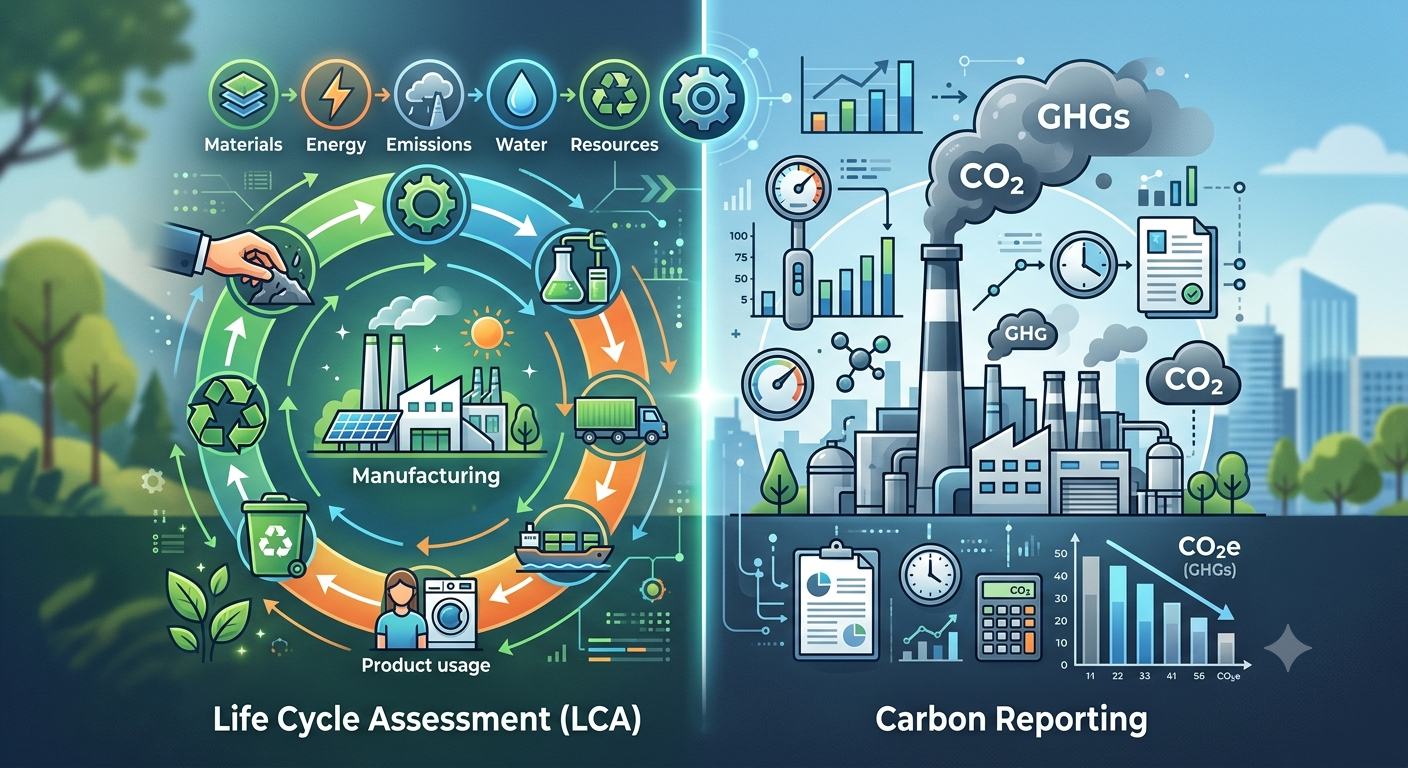
Carbon reporting quantifies greenhouse gas (GHG) emissions associated with an organisation, product, or activity.
While often called “carbon” reporting, it includes multiple greenhouse gases converted into CO₂-equivalent (CO₂e), such as:
- Methane (CH4): From agriculture, natural gas, landfills.
- Nitrous Oxide (N2O): From agricultural soils, industrial processes.
- Water Vapor (H2O): A natural and significant GHG, increasing with warming.
- Ozone (O3): Ground-level ozone.
- Fluorinated Gases (e.g., CFCs, HFCs): Human-made, potent GHGs.
Carbon reporting answers a specific question:
How much greenhouse gas is emitted?
It is typically structured around:
- Scope 1 – Direct emissions
- Scope 2 – Purchased energy
- Scope 3 – Value chain emissions
Its primary purpose is accountability — supporting:
- Regulatory compliance
- Investor disclosure
- ESG reporting
- Target tracking and benchmarking
Carbon reporting tells you how much you emit.
It does not always tell you where systemic environmental trade-offs occur.
What Is Life Cycle Assessment (LCA) Methodology?
Life cycle assessment LCA methodology takes a broader systems perspective.
Rather than focusing only on carbon, LCA methodology evaluates multiple environmental impacts across the entire life cycle of a product or service — from raw material extraction to manufacturing, distribution, use, and end-of-life.
This is often referred to as a “cradle-to-grave” assessment.
LCA Methodology Typically Measures:
- Climate impact (carbon footprint)
- Water consumption
- Resource depletion
- Land use
- Energy demand
- Toxicity impacts
The key question LCA methodology answers is:
What is the total environmental impact of this product or decision over its entire life cycle?
This systems-based perspective makes LCA especially powerful for procurement, product design, and supply chain strategy.
Why Carbon Reporting Alone Can Lead to Incomplete Decisions
Carbon reporting is essential — but limited in scope.
Because it focuses on emissions totals, it may overlook environmental trade-offs. A decision that reduces carbon could increase:
- Water use
- Toxicity
- Resource extraction
- Biodiversity impacts
Without applying life cycle assessment LCA methodology, organisations risk shifting environmental burdens rather than reducing them.
That is why mature sustainability strategies increasingly combine:
- Carbon reporting → for disclosure
- LCA methodology → for decision intelligence
How LCA Methodology Supports Sustainable Procurement
LCA methodology is particularly valuable in procurement and supply chain management.
It allows organisations to compare suppliers or products based on whole-life environmental performance — not just cost or operational emissions.
This aligns directly with the principles of ISO 20400, which promotes sustainable procurement practices across value chains.
By applying life cycle assessment methodology in procurement, organisations can:
- Identify environmental hotspots
- Avoid unintended impact trade-offs
- Compare suppliers on evidence-based criteria
- Support long-term ESG objectives
If you are embedding sustainability into purchasing decisions, you may also find our guide on sustainable procurement implementation helpful.
Carbon Reporting Is About Disclosure. LCA Methodology Is About Understanding.
The simplest way to distinguish them is intent.
Carbon Reporting Supports:
- Regulatory compliance
- Public disclosure
- Investor confidence
- Emissions reduction targets
LCA Methodology Supports:
- Product design optimisation
- Sustainable procurement decisions
- Strategic planning
- Environmental impact reduction
They are complementary — not interchangeable.
Why Organisations Increasingly Need Both
As ESG scrutiny increases, relying on a single measurement tool is no longer sufficient.
Carbon reporting ensures transparency.
Life cycle assessment LCA methodology ensures intelligent improvement.
Together they allow organisations to:
- Report accurately
- Improve strategically
- Align sustainability with business performance
- Strengthen credibility with stakeholders
How ISO 20400 Connects LCA and Carbon Reporting
ISO 20400 provides guidance on embedding sustainability into procurement decisions.
Procurement choices influence environmental impact far beyond organisational boundaries. That’s why understanding the distinction between carbon reporting and LCA methodology is critical.
- LCA provides the impact evidence base.
- Carbon reporting tracks and communicates results.
Used together, they enable procurement decisions that are both compliant and genuinely responsible.
You may also want to explore our article on Scope 3 emissions in procurement for a deeper understanding of value chain reporting. (Internal link suggestion: anchor text “Scope 3 emissions explained”.)
Frequently Asked Questions (FAQs)
Is carbon reporting the same as life cycle assessment LCA methodology?
No. Carbon reporting measures greenhouse gas emissions only. Life cycle assessment LCA methodology evaluates multiple environmental impacts across a full product or service life cycle.
Can LCA methodology include carbon footprint data?
Yes. Carbon footprint is one impact category within LCA methodology. However, LCA goes beyond carbon to assess broader environmental impacts.
Do organisations need both LCA and carbon reporting?
In most cases, yes. Carbon reporting supports compliance and disclosure. LCA methodology supports better product design, procurement decisions, and long-term sustainability strategy.
Is LCA methodology only for large organisations?
No. While comprehensive LCAs can be complex, the methodology can be scaled and prioritised based on impact and business needs.
How does LCA support ISO 20400 implementation?
LCA provides the environmental data needed to make evidence-based procurement decisions aligned with ISO 20400 sustainable procurement principles.
Final Thoughts: It’s Not Either-Or
LCA methodology and carbon reporting are not competing tools.
Carbon reporting tells you how much you emit. Life cycle assessment LCA methodology tells you where impact occurs and how to improve it.
Organisations that understand this distinction move beyond surface-level sustainability and towards meaningful, measurable environmental performance — especially when aligned with frameworks such as ISO 20400.